Guide
Type events as text.
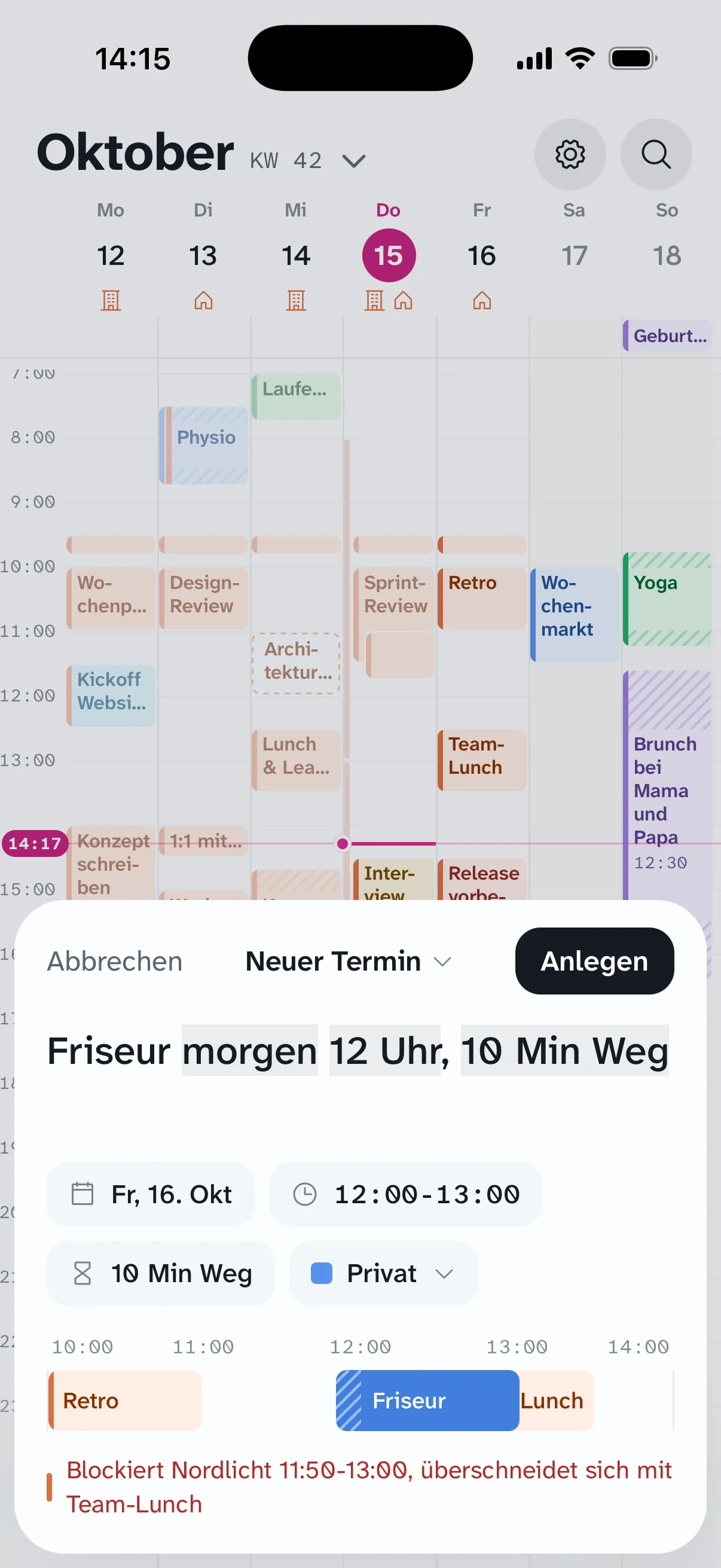
On iPhone, “+” opens quick entry: one field, one sentence, done. Zulu recognizes day, time, duration, travel time, location, and calendar, highlights the recognized parts in gray, and shows below where the event lands and what sits next to it. Whatever isn’t recognized is the title. The parser understands German for now; the examples are German.
As of:
Examples
| Input | Result |
|---|---|
Physio morgen 8 Uhr, 15 Min Weg | “Physio,” tomorrow 8:00 to 9:00, 15 minutes travel time before |
Friseur Fr 12 Uhr 45 Min | “Friseur” (haircut), next Friday 12:00 to 12:45 |
Vorlesung 17.10. 10-12 Uhr @ Hörsaal 3 #Uni | “Vorlesung” (lecture), October 17, 10:00 to 12:00, location “Hörsaal 3,” in the calendar “Uni” |
Oma besuchen Sonntag | “Oma besuchen” (visit grandma), all day on Sunday |
Messe 17.-19.10. | “Messe” (trade fair), all day across three days |
Kaffee halb 3 | “Kaffee,” today 14:30 to 15:30 (tomorrow if already past) |
Zahnarzt in 2 Wochen um 9, Rückweg 20 Min | “Zahnarzt” (dentist), in 14 days 9:00 to 10:00, 20 minutes travel time after |
Day
heute(today),morgen(tomorrow),übermorgen(the day after), alsomorgen früh. “am Morgen” (in the morning) stays in the title.in 3 Tagen(in 3 days),in 2 Wochen(in 2 weeks),nächste Woche(Monday of next week).- Weekdays:
Freitag,am Freitag,nächsten Freitag. Abbreviated (Fr,Mo) only capitalized and only when a time or date follows, so that “So schön” doesn’t become a Sunday. - Dates:
17.10.,17.10.2026,17. Oktober,17 Okt 2027. Without a year, the next matching date applies. - Ranges:
17.-19.10.,17. bis 19. Oktober. They give an all-day event across all days. - Without a day, today applies if the time hasn’t passed yet, otherwise tomorrow.
Time and duration
8 Uhr,8:30,um 8,ab 8,halb 9(half past eight).8.30only with “Uhr” after it.- From–to:
8-9,8:30 bis 10,von 8 bis 10 Uhr. “2 bis 3” on its own is too ambiguous and stays in the title; “2-3” works. - Duration:
45 Min,2 Std,für 1,5 Stunden. Without a duration it’s 60 minutes. If there is an end time, the duration is ignored. ganztägigorganztags(all day); a day without a time is all day as well.- Without a time, the event starts at the next full half hour.
Travel time, location, calendar
- Travel time before:
15 Min Weg,mit 20 Min Anfahrt,Anfahrt 20 Min. After:Rückweg 10 Min,10 Min Rückweg. More under Travel time. - Location:
@ Praxis Müller. It runs until the next comma or the next recognized part:@ Praxis morgen 8 Uhrgives the location “Praxis.” - Calendar:
#Privat,#Uni. Zulu looks for the matching calendar; otherwise you pick it in the bar.
The rules behind it
- The text is read from the left. At every position the longest match wins; per kind (day, time, duration, travel time, return trip, location, calendar) only the first counts, further ones stay in the title.
- Recognition happens only at word boundaries and ignores case, except for abbreviated weekdays.
- A tap on the day or time chip opens start and end as pickers. What you set there applies until the text yields a different time.
- A long press in the grid opens quick entry with the pressed time span; text without day and time takes it over.
- The heading “Neuer Termin ▾” switches to out of office or working location; both exist only in the primary calendar of a Google account.
- Recognition runs on the device; nothing is sent to a service for it.